
The Films of Gordon Matta-Clark
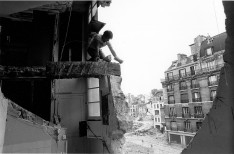
Conical Intersect (1975), courtesy of the Estate of Gordon Matta-Clark
Los Angeles Filmforum presents
The Films of Gordon Matta-Clark
Sunday April 19, 2026, 1:00 pm
At 2220 Arts + Archives, 2220 Beverly Blvd., Los Angeles CA 90057
NOTE THE CHANGE IN TIME
In person: curators Jessamyn Fiore, Director of the Estate of Gordon Matta-Clark, and Dylan Adamson
Tickets: $15 general, $10 students/seniors, free for Filmforum members
Gordon Matta-Clark, the artist, urban explorer, and “anarchitect” most famous for the “building cuts” he performed on various decomposing structures in the 1970s, made 18 short films before his untimely death from cancer in 1978. Aside from walking through the buildings themselves, which have all since been demolished, film provides the ideal venue in which to experience Matta-Clark’s singular artistry. The power of the cut to create strange new juxtapositions, the epistemological faculty of an opening that introduces light to new planes — metaphorical connections between Matta-Clark’s work and the cinematic apparatus abound. This program collects six of his films shot between 1971 and 1976, documenting three building cuts, one site-specific intervention, one formal experiment, and one car crash. In all of his work, Matta-Clark sought to expose the thinness of the boundaries that divide people, mediums, spaces, and ideas. With sledgehammer, chainsaw, and his own two feet, he punched through these walls with an urgency that has been increasingly felt in the decades since his passing, cutting new holes for light to pour in.
Born in New York City in 1943, Gordon Matta-Clark studied architecture and graduated from Cornell University in 1968, returning to his native New York City the following year. Combining his activist concerns with his artistic production, he helped establish alternative spaces such as 112 Greene Street, and the Food Restaurant in SoHo and engaged with peer artists and non-artists in collaboration that aimed to improve their surroundings. In the 1970s, Matta-Clark experimented across various media and began staging monumental interventions and smaller-scale installations in the charged city landscape, bringing attention to New York's failing social policies, displaced people, and abandoned spaces. Through his many projects—including large-scale architectural interventions in which he physically cut through buildings slated for demolition—Matta-Clark developed a singular body of work that critically examined the structures of the built environment. Gordon Matta-Clark died from cancer in 1978 at the age of 35.
Jessamyn Fiore is the Director of the Estate of Gordon Matta-Clark as well as a curator and writer. Her curated exhibitions include 112 Greene Street: The Early Years (1970–1974) at David Zwirner in New York (2011), which led to her editing the critically acclaimed, eponymous catalogue, published by David Zwirner and Radius Books (2012). She co-curated (with Sergio Bessa) Gordon Matta-Clark: Anarchitect at The Bronx Museum of the Arts that opened in November 2017 and subsequently toured to the Jeu de Paume, Paris (2018); Kumu Kunstimuuseum, Tallinn, Estonia (2019); and the Rose Art Museum at Brandeis University, Waltham, Massachusetts (2019). She recently co-curated Gordon Matta-Clark: Graffiti Archive 1972/73 with Roger Gastman of Beyond the Streets for White Columns gallery, New York City (March 2025).
Dylan Adamson is a critic and programmer based in Toronto. His writing on cinema can be found at MUBI Notebook, The Walrus, Los Angeles Review of Books, Screen Slate, Ultra Dogme, and elsewhere. He is currently employed as Technical and Collections Manager at Vtape, the Canadian video art distributor, and has previously guest-programmed at TIFF Cinematheque, Cinémathèque Québécoise, and Anthology Film Archives in New York.
Screening:
All screening in 16mm, TRT 80 min.
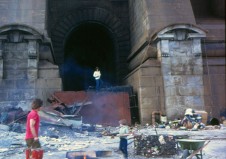
Fire Child, courtesy of the Estate of Gordon Matta-Clark
Fire Child
1971, 16mm, 10 min.
Inspired by the first Earth Day celebrated in 1970, Matta-Clark sculpted a “garbage wall” made from tin cans, waste paper, and other assorted junk under the Brooklyn Bridge. To mark the so-called “Brooklyn Bridge Event,” the group of artists roasted a pig and distributed the meat.
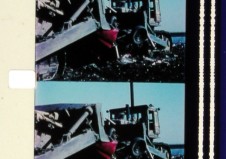
Fresh Kill, courtesy of the Estate of Gordon Matta-Clark
Fresh Kill
1972, 16 mm, 13 min.
Matta-Clark records in full the deliberate crashing of his truck, nicknamed “Herman Maydag,” in this film made for Documenta 5 in Kassel, West Germany. Documenting his unceasing interest in end-of-life processes and their potential for renewal, the artist himself nearly died in the truck while filming.
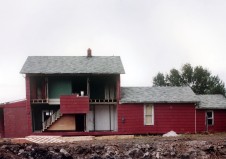
Bingo/Ninths, courtesy of the Estate of Gordon Matta-Clark
Bingo/Ninths
1974, 16mm, 10 min.
A playful experiment with boundaries and decomposition. Travelling to Niagara Falls, New York, in August 1974, Matta-Clark created a plan to divide the exterior facade of a house marked for demolition into nine parts. The segments were removed one by one mere hours before bulldozers arrived.
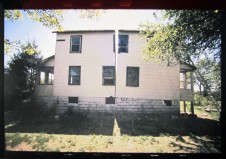
Splitting, courtesy of the Estate of Gordon Matta-Clark
Splitting
1974, 16 mm, 11 min.
From March to June 1974, Matta-Clark drove to the former working class suburb of Englewood, New Jersey, to carve a vertical slice down the middle of a residential house. The gap—propped open by a few jacks placed delicately at corners—introduces light, the world, and a sense of possibility to this soon-to-be-demolished domicile.
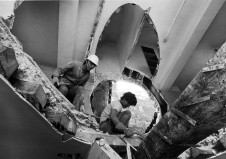
Conical Intersect, courtesy of the Estate of Gordon Matta-Clark
Conical Intersect
1975, 16mm, 19 min.
For the 1975 Paris Biennale, across the street from the construction site of the Centre Georges Pompidou, Matta-Clark carved his most ambitious building cut to date. Inspired by filmmaker Anthony McCall’s “light sculptures,” the cuts take the shape of a bending cone, exposing the building’s centuries of history amidst the transforming neighbourhood.
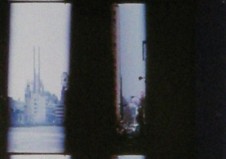
City Slivers, courtesy of the estate of Gordon Matta-Clark
City Slivers
1976, 16mm, 15 min.
Dedicated to his brother Batan, who had recently died after falling from the window of Matta-Clark’s loft, this film presents a series of microscopic views of New York City streets, with the negative exposed one “sliver” at a time before being rewound and an adjacent sliver exposed. As with the building cuts, this film toys with a containerization of space to gesture at the abyss outside.