
Gunvor Nelson Tribute, program 2: Moons Pool

My Name Is Oona, by Gunvor Nelson. Image courtesy of Filmform (Sweden)
The Academy Museum, Los Angeles Filmforum, the UCLA Film & Television Archive, and Rotations LA present
Gunvor Nelson Tribute, program 2: Moons Pool
Friday March 27, 2026, 7:30 pm
At the Academy Museum, Ted Mann Theater, 6067 Wilshire Boulevard Los Angeles, CA 90036
Video Introduction by Lynne Sachs
Tickets: $5 general,
https://www.academymuseum.org/calendar?start=2026-03-27&end=2026-03-28
The second of three screenings, this program highlights the early classic films that made her reputation, often collaborating with Dorothy Wiley or Robert Nelson. The early films are based around the experiences of a younger woman, culminating in My Name Is Oona (1969), an expressive portrait of her daughter, and “Moons Pool” (1973), an existentially expressive underwater journey which centers on her own body.
A pioneer of personal cinema and feminist film who never shied away from challenges, Nelson's innovative films combine painting, collage, and sound experimentation, embodying humor, resistance, intimacy, and tactile sensation. Her early films frequently reflect the inner and outer qualities, thoughts, and voices of women in the 1960s and 70s; homes, daughters, and mothers are particularly important themes in her work. Moving from painting to still photography, from analog film to digital media, as each new medium collides with a multitude of everyday objects, her work delves deeper into the texture of life and the saturated past, uncovering an intuitive yet delicate sensibility that retreats from the real world into another, imaginatively reconstructed one. During her time teaching in San Francisco, Nelson inspired countless experimental filmmakers and artists. After returning to Sweden, she continued exploring and experimenting with new audio-visual languages, leaving us with a rich and unimaginable legacy.
This retrospective will cover a range of Nelson's works, from her debut film, a feminist classic, “Schmeerguntz” (1966) (co-directed with Dorothy Wiley), to the late abstract video art “Snowdrift a.k.a. Snowstorm” (2001), with several other essential and influential masterpieces created in the years between.
The program trilogy will be co-presented by LA Filmforum, Rotations LA, the Academy Museum, and the UCLA Film & Television Archive.
Program 1 will be at Los Angeles Filmforum at 2220 Arts on March 22
https://www.lafilmforum.org/schedule/winter-2026/gunvor-nelson-tribute-program-1-red-shift/
Program 3 will be at the Billy Wilder Theater at the Hammer Museum on Saturday March 28.
https://www.cinema.ucla.edu/events/gunvor-nelson-tribute-iii-light-years-expanding-2026-03-28/
Curated by Cherlyn Hsing-Hsin Liu and Steve Anker
About the Filmmaker
Gunvor Nelson (1931-2025), was one of the most highly acclaimed filmmakers in classic American avant-garde film. She grew up in Kristinehamn, Sweden, and studied at the University College of Arts, Crafts and Design in Stockholm, but moved to the US and California in 1953 to study art and art history. Nelson met her husband-to-be Robert Nelson when she was studying at the California School of Fine Arts (from 1961 onwards, the San Francisco Art Institute). Robert Nelson is one of the great humorists of the American avant-garde. The Nelsons were a vital part of the new film culture that evolved in the San Francisco area and they played a key role in one of America’s oldest and most respected film cooperatives, the Canyon Cinema. Gunvor Nelson also influenced several generations of filmmakers in her role as a teacher, primarily at the San Francisco Art Institute (1970-1992).
Gunvor Nelson and Dorothy Wiley’s debut Schmeerguntz (1966) is a humorous and grotesque feminist classic in which the everyday reality of a young mother is contrasted with the ideal of the American woman. An uncompromising filmmaker, Nelson has a unique voice in experimental cinema. She regards her own works as “personal films”, a recurring element of which is the connection with her own life and experiences. The early films are based around the experiences of a younger woman, culminating in My Name Is Oona (1969), an expressive portrait of her daughter, and “Moons Pool” (1973), an existentially expressive underwater journey which centers on her own body.
Nelson’s family and generational study “Red Shift” (1984), and her painfully sensitive portrayal of her dying mother in “Time Being” (1991) are regarded as the high points of her family and hometown productions. Around this time (1983-1990) Nelson also made a total of five different collage films at Filmverkstan in Stockholm, works which give free rein to her own associations and her experimentation with animated images. These films are often regarded both as Nelson’s most demanding and most creative works.
Nelson moved back to Kristinehamn and Sweden in December 1992, a homecoming already hinted at in her rhythmically edited collage film Frame Line (1983). Having returned to Sweden she quickly moved on to digital video and was rediscovered in Swedish art circles, resulting in a number of awards and retrospectives both at home and abroad.
Most screening in 16mm, TRT 74 min.
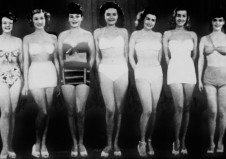
Schmeerguntz
Schmeerguntz
1966, 16mm, b&w, sound, 15 min.
This was the film that set everything in motion. Schmeerguntz, coined after Nelson’s father’s non-sense word for sandwich (‘smörgås’ in Swedish), is a hilarious, grotesque and grave attack on the public ideal of the American housewife. Critic Ernest Callenbach wrote in excitement that ‘A society which hides its animal functions beneath a shiny public surface deserves to have such films as Schmeerguntz shown everywhere’. – Professor John Sundholm, Stockholm University
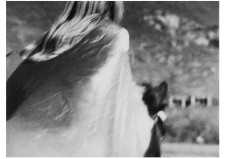
My Name is Oona
My Name is Oona
1969, 16mm, b&w, sound, 10 min.
My Name is Oona was Nelson’s final breakthrough on the American avant-garde film scene. The sound consists of Nelson’s daughter, Oona, repeating the names of the days of the week and of her saying “my name is Oona”. The latter is edited into an expressive rhythmical structure that accompanies the visual structure of the film that plunges into the experience of a child where both bliss and fear reigns. As so often in Nelson’s oeuvre there is a female subtext too: it is male voices that executes their authority upon Oona, whereas as a girl she is still equal to boys of her own age. – Professor John Sundholm, Stockholm University
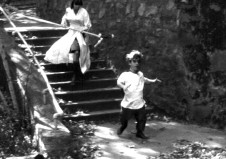
Fog Pumas
Fog Pumas
1967, 16mm, b&w and color, sound, 25 min.
Fog Pumas is the second film that Gunvor Nelson and Dorothy Wiley shot together. It received one of the grand prizes at the Knokke Experimental Film Festival, EXPRMTL, in 1967-68. The film is a hilarious, liberating, exploration of absurd imagery and situations in which Nelson and Wiley also make fun of some classical avantgarde film techniques. It is an empowering film, made in the spirit of exploring the potentialities of filmmaking and insisting upon having fun while doing it. – Professor John Sundholm, Stockholm University
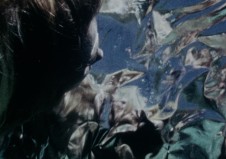
Moons Pool
Moons Pool
1973, 16mm screened as digital video, color, sound, 15 min.
Moons Pool marks a new path in Gunvor Nelson’s filmmaking in which she develops her interest in creating a weave of movements and superimpositions. The film that is mostly shot underwater, in a pool, begins with footage of water and a close-up of Nelson from which we move to her body immersed in water in a bath-tub from which yet another transition occurs to a pool with male and female naked bodies swimming underwater. The latter part of the film is almost totally liberated from speech, and has a dreamlike, complex soundtrack consisting of sounds of waves, voices, water and music woven together into a seamless web of sounds.– Professor John Sundholm, Stockholm University
Snowdrift a.k.a. Snowstorm
Snowdrift a.k.a. Snowstorm
2001, digital, color, sound, 9 min.
Movement begins and ends with snowflakes, fleeting, floating, whirling and dancing in constant restlessness. Sudden changes in direction, composition, background, density, color and contrast interrupt the perpetual flow. – Professor John Sundholm, Stockholm University