
Gunvor Nelson Tribute, program 1: Red Shift
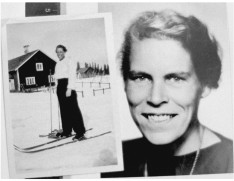
Time Being (1991) by Gunvor Nelson
Los Angeles Filmforum and Rotations present
Gunvor Nelson Tribute, program 1: Red Shift
Sunday March 22, 2026, 7:30 pm
At 2220 Arts + Archives, 2220 Beverly Blvd., Los Angeles CA 90057
Co-presented by the Academy Museum, and the UCLA Film & Television Archive
In person introduction by Steve Anker
Tickets: $15 general, $10 students/seniors, free for Filmforum members
https://link.dice.fm/n6e5022d46bd
A pioneer of personal cinema and feminist film who never shied away from challenges, Nelson's innovative films combine painting, collage, and sound experimentation, embodying humor, resistance, intimacy, and tactile sensation. Her early films frequently reflect the inner and outer qualities, thoughts, and voices of women in the 1960s and 70s; homes, daughters, and mothers are particularly important themes in her work. Moving from painting to still photography, from analog film to digital media, as each new medium collides with a multitude of everyday objects, her work delves deeper into the texture of life and the saturated past, uncovering an intuitive yet delicate sensibility that retreats from the real world into another, imaginatively reconstructed one. During her time teaching in San Francisco, Nelson inspired countless experimental filmmakers and artists. After returning to Sweden, she continued exploring and experimenting with new audio-visual languages, leaving us with a rich and unimaginable legacy.
This retrospective will cover a range of Nelson's works, from her debut film, a feminist classic, “Schmeerguntz” (1966) (co-directed with Dorothy Wiley), to the late abstract video art “Snowdrift a.k.a. Snowstorm” (2001), with several other essential and influential masterpieces created in the years between.
The program trilogy will be co-presented by LA Filmforum, Rotations LA, the Academy Museum, and the UCLA Film & Television Archive.
Program 2 will be at the Academy Museum on Friday March 27.
https://www.academymuseum.org/programs/detail/gunvor-nelson-tribute-ii-moons-pool-019be219-d804-b817-96ac-a119453fa67b
Program 3 will be at the Billy Wilder Theater at the Hammer Museum on Saturday March 28.
https://www.cinema.ucla.edu/events/gunvor-nelson-tribute-iii-light-years-expanding-2026-03-28/
Curated by Cherlyn Hsing-Hsin Liu and Steve Anker
About the Filmmaker
Gunvor Nelson (1931-2025), was one of the most highly acclaimed filmmakers in classic American avant-garde film. She grew up in Kristinehamn, Sweden, and studied at the University College of Arts, Crafts and Design in Stockholm, but moved to the US and California in 1953 to study art and art history. Nelson met her husband-to-be Robert Nelson when she was studying at the California School of Fine Arts (from 1961 onwards, the San Francisco Art Institute). Robert Nelson is one of the great humorists of the American avant-garde. The Nelsons were a vital part of the new film culture that evolved in the San Francisco area and they played a key role in one of America’s oldest and most respected film cooperatives, the Canyon Cinema. Gunvor Nelson also influenced several generations of filmmakers in her role as a teacher, primarily at the San Francisco Art Institute (1970-1992).
Gunvor Nelson and Dorothy Wiley’s debut “Schmeerguntz” (1966) is a humorous and grotesque feminist classic in which the everyday reality of a young mother is contrasted with the ideal of the American woman. An uncompromising filmmaker, Nelson has a unique voice in experimental cinema. She regards her own works as “personal films”, a recurring element of which is the connection with her own life and experiences. The early films are based around the experiences of a younger woman, culminating in “My Name Is Oona” (1969), an expressive portrait of her daughter, and “Moons Pool” (1973), an existentially expressive underwater journey which centers on her own body.
Nelson’s family and generational study “Red Shift” (1984), and her painfully sensitive portrayal of her dying mother in “Time Being” (1991) are regarded as the high points of her family and hometown productions. Around this time (1983-1990) Nelson also made a total of five different collage films at Filmverkstan in Stockholm, works which give free rein to her own associations and her experimentation with animated images. These films are often regarded both as Nelson’s most demanding and most creative works.
Nelson moved back to Kristinehamn and Sweden in December 1992, a homecoming already hinted at in her rhythmically edited collage film Frame Line (1983). Having returned to Sweden she quickly moved on to digital video and was rediscovered in Swedish art circles, resulting in a number of awards and retrospectives both at home and abroad.
Screening:
All screening in 16mm, TRT 80 min.
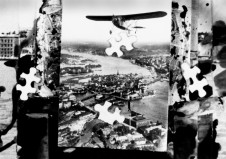
Frame Line, by Gunvor Nelson
Frame Line
1983, 16mm, B&W, sound, 22 min.
Frame Line is Nelson’s first collage film. The film that inaugurated her original series of animated films, all made at the Film Workshop in Stockholm. Frame Line is a reflection on Stockholm and Sweden, on Nelson’s return to her native country and a place that is both familiar and distant, both beautiful and ugly at the same time. The film begins with images and glimpses of Stockholm that Nelson has collected, then developing this audiovisual material into a new visual work where animation becomes a way of discovering both what the camera has captured and what can be created anew through free association. – Filmform, Sweden

Red Shift
Red Shift
1984, 16mm, B&W, sound, 16mm, 50 min.
Red Shift is one of Nelson’s most admired films, a dense narrative film about family relations in which the various roles are played by members of her family. The film merges two diegetic times, both present and past, and pending between close-ups and long shots. Nelson’s depiction of family life is both candid and considerate, displaying an amalgamation of emotions ranging from delight to distress. - John Sundholm, Professor in Film History at Stockholm University
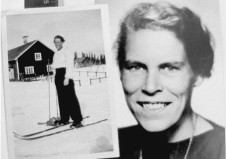
Time Being
Time Being
1991, 16mm, B&W, silent, 8 min.
Time Being is a commemoration in four sequences of Nelson’s mother. The film that starts and ends with lengthy black leader, is a brutal yet beautiful depiction of her mother dying and how the bond between them is cut off. After a prologue follows series of three shots, each beginning in static takes of her mother lying in a bed at a hospital. For each shot the distance to the mother increases and the camera moves closer towards Nelson. – Filmform, Sweden