
Filmforum 50, program 9: An Evening with Morgan Fisher
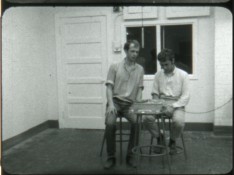
"The Director and His Actor Look at Footage Showing Preparations for an Unmade Film (2)"
Los Angeles Filmforum presents
Filmforum 50, program 9: An Evening with Morgan Fisher
Sunday February 15, 2026, 7:30 pm
At 2220 Arts + Archives, 2220 Beverly Blvd., Los Angeles CA 90057
In person: Morgan Fisher
Tickets: $15 general, $10 students/seniors, free for Filmforum members
A crucial participant and creator of experimental film in Los Angeles for close to sixty years, Morgan Fisher’s precise and beautiful films each address aspects of the processes of filmmaking with humor and conceptual rigor. As a member of the Los Angeles Independent Film Oasis (along with other key figures such as Pat and Beverly O’Neill, David and Diana Wilson, and Amy Halpern), he helped Los Angeles audiences have the opportunity to see essential films works in the late 1970s and early 1980s. His painting practice, which evolves from his same concerns with essential processes, color, and elements of personal history, has been featured in multiple exhibitions. Filmforum last hosted a one-person program with Fisher in 2004, and we’re delighted to honor him with some of the highlights of his cinematic oeuvre as part of our 50th anniversary celebration.
“Focusing with rare intensity and insight upon the construction (and deconstruction) of cinematic illusionism, Fisher’s earliest films, such as “The Director and His Actor Look at Footage Showing Preparations for an Unmade Film (2)” and “Production Stills,” revealed the careful self-reflexivity and theoretical sophistication that have remained important trademarks of his work. Fisher’s late masterpieces “Standard Gauge” and “( )” have added another dimension to his meta-cinematic concerns, channeling Fisher’s ardent love, and deep knowledge, of cinema into a heartfelt, and at times distinctly melancholy, searching for the essence of film. Fisher’s late films offer a radical, “termite” history of the cinema from within the machine, a recovery and even an ontology, of precisely those film techniques and technologies that are typically overlooked and, paradoxically, designed to be invisible- the insert, film gauges, and the motion picture camera itself…”Haden Guest, Harvard Film Archive, https://harvardfilmarchive.org/programs/morgan-fisher-presents
“In a way, Morgan Fisher (Washington DC, 1942) is the missing link between that Hollywood idea of films and experimental cinema, thanks to a series of works that intelligently break down the conventions of industrial cinema with humor, in a line of conceptual thought that smacks of avant-garde. Most of Fisher’s films are true meta-cinema, films that say “You’re watching a movie,” and the movie you’re watching is about making a movie that has been emptied of any content other than just that. Fisher’s films have been called “structural cinema” due to their material approach to cinema, but the truth is that this idea is not entirely correct, since his interest is directed more towards conventional procedures, which in the years when he began working in the late sixties inevitably involved working with celluloid, projectors, synchronization methods, cameras and other paraphernalia (which, curiously, all continues to graphically represent cinema). Each film is a carefully thought-out system, where the ultimate decisions are taken by industrial standards: the duration of the film reels, the apparatus most often used, the regulated procedures, and the predetermined categories. Fisher, who is also a painter and adapts this way of doing things to painting, has expressed his closeness to Duchamp and the ready-made, and in a certain way what he does in his cinema is to place that industrially manufactured object in front of our eyes so that what is important in the work is not the work itself but the gesture it proclaims.’ Elena Duque, https://s8cinema.com/en/2024/05/20/morgan-fisher-2-en/
Morgan Fisher was born in Washington, D.C., in 1942. He studied at Harvard College, receiving a B.A. in art history in 1965. Moved to Los Angeles to attend film school. Began making short films in 1968. Films shown at film festivals (Oberhausen, Berlin, Pesaro, London, New York, etc., and most recently at (S8) Mostra de Cinema Periférico, A Coruña, in 2024, and in museums (Museum of Contemporary Art, Los Angeles, Museum of Modern Art, Whitney Museum of American Art, Tate Modern, Centre Pompidou, etc.). His films have been in two Whitney Biennials (1984, 2005). His most recent film, “Another Movie” (2017), was shown at the Berlin and London festivals, Courtisane, Curtas Vila do Conde, and the Museum of Modern Art. Toward the end of the 1990s he extended his practice to include painting, drawing, photography, and installation. His non-film work has been exhibited at, among other places, REDCAT, Portikus, Raven Row, Museum Abteiberg, Generali Foundation, and the 2014 Whitney Biennial. Fisher has been a visiting teacher at Brown University, California Institute of the Arts, and the University of California, Los Angeles. He shows with Galerie Buchholz, Cologne/Berlin/New York, Maureen Paley, London, and Bortolami, New York. A book of his writings on his work in film and other media was published by Walther König in 2013. He lives and works in Los Angeles.
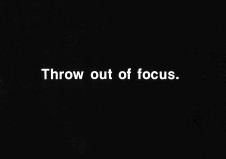
Projection Instructions
Projection Instructions
1976, 16mm, b&w, sound, 4 min.
Print courtesy of the Academy Film Archive
Performed by Mark Toscano
“With “Projection Instructions” Morgan Fisher turns his interest to the screening space and the act of projection. Every film must be performed by the projectionist, but generally the projectionist's job is done correctly when it goes unnoticed. “Projection Instructions” puts the projectionist at the centre of the work, requiring his full attention, as all the textual instructions on the screen (“Turn sound off”, “Throw out of focus”...) need to be read and respected.
“The projectionist is no longer the means for delivering the performances of actors to the audience; the projectionist is a performer who, at Fisher’s instruction (or, in a sense, at the film’s instruction), succinctly demonstrates (or fails to demonstrate) the various dimensions of the viewing experience controlled from the projection booth. – Scott McDonald
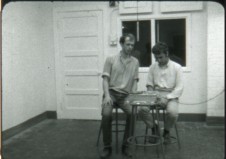
The Director and His Actor Look at Footage Showing Preparations for an Unmade Film (2)
The Director and His Actor Look at Footage Showing Preparations for an Unmade Film (2)
1968, USA, 16mm, b/w, sound, 15 min.
Print courtesy of the Morgan Fisher Collection at the Academy Film Archive
A film in 5 sections; each of them is a single roll of 16mm film long. We see a bare room with a young man sitting behind a tape recorder. Another man, played by Fisher himself, busily enters; he tests the recording machine and eventually goes into a back room, which, when illuminated, turns out to be a projection booth. Each section of the film elaborates the situation of the director and his actor working on an unfinished film which gradually becomes the film we are watching, but which is not the film they were working on. Throughout we hear the comments of the two men as they watch the rushes of their film. Watching rushes is part of the necessary procedures of the film making process, which must remain invisible in the finished film. In this work, however, procedure itself is the subject.
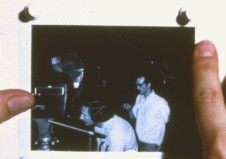
Production Stills
Production Stills
1970, 16mm, color, sound, 11 min.
Print courtesy of the Morgan Fisher Collection at the Academy Film Archive
“Fisher’s films are, in truth, only part of a more expansive art practice and his Production Stills was, tellingly, screened in 1970 at the Museum of Modern Art in conjunction with its historic “Information” show, among the first US museum exhibits devoted to conceptual art.” – Haden Guest, Harvard Film Archives
As its title indicates, the subject in “Production Stills” is a series of production stills of a film that was never made, and that at the same time is the film we are watching. Scott McDonald calls Production Stills “the quintessential Fisher film”. A perfectly enclosed narrative of its own production: the image is one long take (again 11 minutes) of a wall on which a hand sequentially pins a number of Polaroids, one after the other. The Polaroids depict the crew making the film; the synchronous sound allows us to hear in real time their chatter and the hum of the still camera, so that we can anticipate the photos and assign faces to the voices we hear.
Standard Gauge
Standard Gauge
1984, 16mm, color, sound, 35 min.
Print courtesy of the Morgan Fisher Collection at the Academy Film Archive
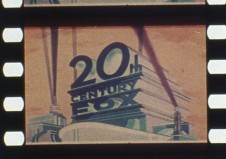
“While on one level, "Standard Gauge" is Fisher’s homage to 35mm and to the diverse cinematic world it made possible, the irony of its having been filmed in 16mm reveals a conceptual paradox central to the film, and which unites it with the webs of irony and paradox evident in his earlier work. …As Fisher explains in his program notes, the thirty-two minute shot “…is virtually the maximum length of a scene in 16mm, and is longer by far than 35mm is capable of”. For all its potentials and accomplishments, standard gauge is limited, and in ways that a non standard gauge - a gauge quite marginal to mainstream film history - is not.” -- Scott MacDonald
An autobiographical account of Fisher’s experiences as an editor in the commercial film industry during the early seventies. Filming a succession of divergent film scraps rejected at the editing stage, Fisher comments on the origin and meaning of each image, thus exploring the mechanisms and conditions of film production, in both its materialistic and institutional aspects.
( )
( )
Aka “Inserts”
2003, 16mm, color & b&w, silent, 21 min.
Print courtesy of the Morgan Fisher Collection at the Academy Film Archive
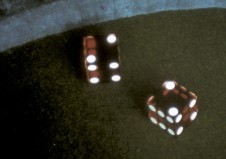
The origin of ( ) was my fascination with inserts. Inserts are a crucial kind of shot in the syntax of narrative films. …I wanted to free the inserts from their stories, I wanted them to have as much autonomy as they could. I thought that discontinuity, cutting from one film to another, was the best way to do this. It is narrative that creates the need for an insert, assigns an insert to its place and keeps it there. The less the sense of narrative, the greater the freedom each insert would have. But of course any succession of shots, no matter how disparate, brings into play the principles of montage. That cannot be helped. Where there is juxtaposition we assume specific intention and so look for meaning. Even if there is no specific intention, and here there is none, we still look for meaning, some way of understanding the juxtapositions. – Morgan Fisher