
Filmforum 50, program 7: Vision of the Fire Tree
Persian Series, by Stan Brakhage
Los Angeles Filmforum presents
Filmforum 50, program 7: “Vision of the Fire Tree”
Films by Stan Brakhage and Phil Solomon
Live performance by Ulrich Krieger, Michael Pisaro-Liu, and Eyvind Kang
Sunday, February 1, 2025, 8:00 pm
At 2220 Arts + Archives, 2220 Beverly Blvd., Los Angeles CA 90057
Tickets: $22 general/students/seniors, $10 for Filmforum members:
https://link.dice.fm/Jaf9077c218f
A very special evening, with classic films by Stan Brakhage and Phil Solomon with live performance by beloved LA composers and musicians, Ulrich Krieger, Michael Pisaro-Liu, and Eyvind Kang. All films will be screened in 16mm.
The program opens with Vision of the Fire Tree. It is, as Brakhage writes, “like a fire in the mind” that “seeks that ‘tree’ along a line of metaphorical synapse.”
Landing in the Cat of the Worm's Green Realm, cats, flames, worms, leaves, sunlight, and tiny creatures thrive in a fantastical world refracted by octagonal prisms—a mysterious, luminous, and boundless visual feast beneath an autumn-hued sky.
Desert gazes directly at the dazzling sun. Yellow sand and mirages.
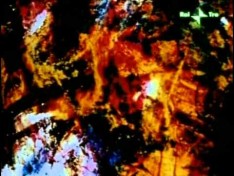
Dried red and yellow rose petals, black and white calligraphic lines, hieroglyphic pinks, greens, and blues. The Persian Series #6-12 is a symphony of bold and delicate emotions, the power of lines and shapes clashing and merging, yet appearing and disappearing like ghosts—indistinct, ultimately…
The program concludes with Phil Solomon's Clepsydra, in which a water-clock rescues us from the lost flames, taking us back to the origin of the universe through the heavy black-and-white noise, where perhaps the "tree" resides.
We wish to acknowledge that these films were originally created in silent film format by the artist, and our performance reflects this, demonstrating our deep understanding and respect for Brakhage's artistic vision. This event celebrates the 50th anniversary of Los Angeles Filmforum, paying tribute to art films and bringing together these musicians who are also devoted fans of Brakhage. This live performance is authorized and approved by Stan Brakhage's widow, Marilyn Brakhage.
Curated by Cherlyn Hsing-Hsin Liu
About the Musicians:
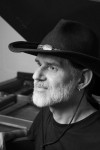
Ulrich Krieger is a German composer and saxophonist living in Southern California. Krieger’s recent focus lies on the experimental fringes of contemporary rock culture, in the limbo where noise, metal, silence, electronic music, improvisation and experimental chamber music meet – not accepting stylistic boundaries. Beside his solo work he performed extensively with his groups Metal Machine Trio and Text of Light. He collaborated and performed with Lou Reed, Merzbow, Carl Stone, John Zorn, Lee Ranaldo, Christian Marclay, Faust, Phill Niblock, Berlin Philharmonics, Ensemble Modern, Musikfabrik, PARTCH Ensemble, and many more. His compositions are widely performed internationally. Krieger studied classical/contemporary saxophone, composition, electronic music, and musicology in Berlin and New York. He is professor for composition and rock music at CalArts.
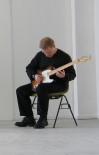
Michael Pisaro-Liu is a guitarist and composer and a long-time member of the Wandelweiser collective. While, like other members of Wandelweiser, Pisaro-Liu is known for pieces of long duration with periods of silence, over the past two decades his work has branched out in many directions, including work with field recording, electronics, improvisation and large ensembles of very different kinds of instrumental constitution. Pisaro-Liu is the Director of Composition and Experimental Music the California Institute of the Arts.
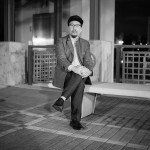
Eyvind Kang’s recent albums are Azure (with Jessika Kenney, 2023), Sonic Gnostic (2021) and Ajaeng Ajaeng (2020). They have performed with musicians including Bennie Maupin, Bill Frisell, Laurie Anderson.
Ulrich Krieger
Eyvind Kang, photo by Alireza Omoumi
Michael Pisaro-Liu
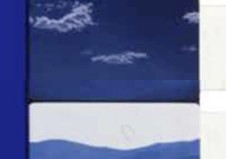
Vision of the Fire Tree
Vision of the Fire Tree
By Stan Brakhage
1991, 16mm, color, silent, 4 min.
It will first be shown as a silent film, as originally intended
"Vitally, the human race is dying. It is like a great uprooted tree with its roots in the air. We must plant ourselves again in the universe." - D.H. Lawrence
This little film, like a fire in the mind, seeks that "tree" along a line of metaphorical synapse.
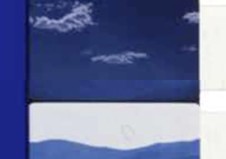
Vision of the Fire Tree
Vision of the Fire Tree
By Stan Brakhage
1991, 16mm, color, Live Performance, 4 min.
This film will be screened again, accompanied by live performance.
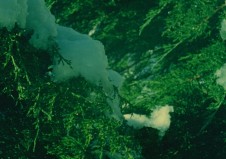
Cat of the Worm's Green Realm
Cat of the Worm's Green Realm
By Stan Brakhage
1994, 16mm, color, Live Performance, 14:00
Flares of color break into streams of light, leaves, wood grain and prism-etched vegetation.
A moon lifts out of this dark weave to be replaced by autumn leaves against a grainy sky, a fiery sky.
The moon, again, caught in clouds. The movements, moonlit, of a cat. Vegetation and toned flares (a kind of "ghost light" midst microscopic photography of leaves and twigs).
A gray cat licks itself, its name-tag reflected in lens refractions midst microscopic visions of ice and snow, autumn leaves, green leaves, a distant snow-laden green scene.
A black cat sits quickly down on a green lawn. A night of shards of forms in darkness passes into a day again ... again an octagonal light shape "echoing" the cat's name-tag midst, now, colored leaves in extreme close-up and at some distance mixed with sun. Again a "night" of showering dark, a "dawn" of pinks and yellows of plant growth in close-up.
A kind of gentle yellow "high noon" prevails into which the orange worm appears and reappears, twisting, arching, turning. A phosphorescent orange of leaves explodes midst greens and black holes appropriate to the image of the worm.
Flares of suns, imprismed midst yellows and greens and vibrant sky blues ... always the forms of many varieties of leafage mix with a veritable rain or clash of overall tones, a fire of forms, a glowing color photo-negative of worm, and the final canopies of autumn tone and sky tone permeated by sun, sun streaks and octagonal prism shapes ad infinitum.
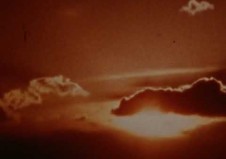
Desert
Desert
By Stan Brakhage
1976, Super 8 to 16mm, color, Live Performance, 10:00
"I want it understood that this 'summary' is written for identification purposes only and that it is not intended as a statement by the artist on his work. It is my belief that statements by the artist, particularly in print, aesthetically speaking, would better have been included in that work in the first place.
"If a film is a work of moving visual art, it is its own subject and subject only to itself. The extent to which a film can be described is the extent to which it is deficient as a work of visual art. If the 'summary of the subject' of a film can be interpreted as that which is intended to inspire perception in the viewer, rather than as that which attempts to describe the film for the viewer, then (the title) is my 'summary of the subject.'"
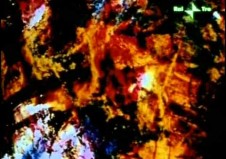
The Persian Series #6-12
The Persian Series #6-12
By Stan Brakhage
1999, 16mm, color, Live Performance, 25:00
PERSIAN SERIES #6 begins with what appears to be dried red and yellow rose petals, suddenly shot-thru with blue which causes a shift to violets and greens. This mash of colors thickens and is scored by white and then black, calligraphic lines, which are "echoed" in all previous floral colors whose "dance" seems to turn clock-wise and "explode" into fiery reds.
PERSIAN SERIES #7: very pale, thin, hieroglyphic pinks, greens and blues in a white space which is thickened over by ribbed mashes of these colors which "dissolve" into varied shapes almost suggesting landscapes and ephemeral bouquets. Dark blurred shapes mix with eachother and give-way to clock-wise-turning pillars of yellow, scored with white glyphs, at times, and fading mashes of tones and, finally, a calligraphic shape.
PERSIAN SERIES #8: Pale petal and stem-like shapes counter punted rhythmically by an even paler "background" of truly ephemeral of truly ephemeral (almost invisible) shapes. Again, the foreground movement is clockwise and often "ribbed" as the film darkens into a blend of foreground/background and, eventually, a meld as of white hardened clots fretted by glyphs.
PERSIAN SERIES #9: sharp edged "chunks" of color set in black, straight, often multicolored, lines piercing shapes, imprisoning them, until they are fragmented bits of color in black: repeat of this theme again and again until darkness prevails, but is then broken open by pure white shards and "spears" restoring the original "dance" of hard-edge shapes and lines, which then begin to whirl block-wise, intersperced with fade-outs, and then shatter into "confetti" texture, in black, burnt "sugar-shapes" and the overwhelming flare of yellow.
PERSIAN SERIES #10: "twigs" of color in space, and pure white "ghosts" of them in the background interspersed with dark amalgams of these and conglomerate forms. The resolve of these themes is a combination of "amalgams" and "ghosts" at one in interplay, and then dark slashed spaces with "webs" of white, webbed spaces on white and, finally, solarization of colored forms - midst which the frame-line rises from bottom and driftes a few seconds visible, creating an insubstantiality of the frame of these images.
PERSIAN SERIES #11 begins with a "window" of yellow paint adrift in the full frame of multicolored paint-shapes. Alternating black-space/white-space exists as a back-drop for slashes and curves of color - reds and blues shifting to red-blue-green, then yellow, etc. slashed in black.
PERSIAN SERIES #12: "hot" by-play of reds-greens-yellows in black, blurred, finally, as the color shapes are shifted violently from side to side, finally ending of a sharp entanglement of multicolored twig-like and/or stem-like forms.
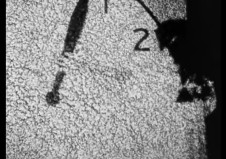
Clepsydra
Clepsydra
By Phil Solomon
1992, 16mm, B&W, Live Performance, 14:00
Clepsydra is an ancient Greek water clock (literally, "to steal water"). This film envisions the strip of celluloid going vertically through a projector as a sprocketed waterfall (random events measured in discreet units of time), through which the silent dreams of a young girl can barely be heard under the din of an irresistable torrent, an irreversible torment.
"Solomon has evolved his technique so that in his latest work ('Clepsydra' - 'waterclock') the textures are constantly changing and are often appropriate to each figure in metaphoric interplay with each figure's gestural (symbolic) movement. He has, thus, created consonance with thought as destroyer/creator - a Kali-like aesthetic 'There is a light at the end of the tunnel' (Romantic); and it is a train coming straight at us: ... (and, to balance such, perhaps, with a touch of Zen) ... it is beautiful!" - Stan Brakhage
Juror's Award (First Prize), Black Maria Film and Video Festival, 1993