
Francisco Romero: Local Reconstructions
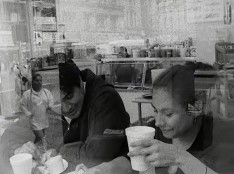
Una Esquina Del Mundo (2004), by Francisco Romero
Los Angeles Filmforum presents
Francisco Romero: Local Reconstructions
World and California premieres!
Francisco Romero in person, in conversation with Diego Robles after the screening
Sunday November 1, 2026, 7:30 pm
At 2220 Arts + Archives, 2220 Beverly Blvd. Los Angeles CA 90057
Tickets: $15 general, $10 students/seniors, free for Filmforum members
https://link.dice.fm/rb0a2f2aaefa
Inside Southern California, our landscapes have been sculpted by massive capital - our homes, our neighborhoods, & even our memories constantly resist being minoritized & made insignificant. Francisco Romero's current film essays, and turn of the century docu-dramas, unearth needed poetic & political context to equip us against this sculpting.
Francisco Romero is an independent filmmaker and artist born in Los Angeles, California. Francisco was raised in the working-class communities of Pico-Union and South Gate, California. Francisco studied Film and Electronic Media at California State Long Beach where he received his BFA as well as CalArts where he received his MFA in Film and Video Production. He has had the opportunity to screen his work at a variety of small and independently run galleries and film festivals throughout Southern California. Currently, Francisco works for the University of California, Irvine as an Education Coordinator and resides in Northeast Los Angeles with his wife and two young children.
----------------------
Los Angeles Filmforum screenings are supported by the California Arts Council, the Los Angeles County Board of Supervisors through the Los Angeles County Department of Arts & Culture, and the Department of Cultural Affairs, City of Los Angeles. We also depend on our members, ticket buyers, and individual donors.
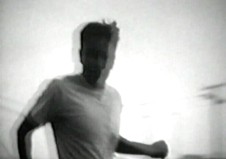
Long Distance Runner
Long Distance Runner
1999, Super-8 transferred to digital, B&W & Color, Sound, 3:52 min. World Premiere!
My second attempt at filmmaking, Long Distance Runner is a short experimental film that follows a man imprisoned by his own geography. Running in circles through familiar streets, he is bound by borders he did not choose. Trapped within the repetitive rhythms of routine and landscape, he pursues freedom along a path that never changes. Constructed through fragments of image, sound, and appropriated text, the film draws from scientific journals documenting experiments in sensory deprivation and animal behavior, alongside excerpts from Ralph Ellison's Invisible Man and Jack Henry Abbott's in the Belly of the Beast. Although not explicitly cited, Mike Davis's City of Quartz also served as a foundational influence. The film reflects on the emergence of the police state, surveillance, and the rigid localism that shaped Los Angeles during the late 1980s and early 1990s. It imagines the city as a landscape where movement is permitted but genuine mobility is constrained. Running becomes less an act of liberation than a ritual of containment. Echoing Davis's concept of "Fortress Los Angeles," Long Distance Runner explores how architecture, policing, and urban planning become technologies of social control. Defensive landscapes, spatial segregation, racial profiling, and constant surveillance transform the city into an invisible prison, where boundaries are enforced not only by walls and freeways but by fear itself. The film presents Los Angeles as a dystopian environment. Beneath the promise of freedom lies a city organized around containment, where geography, power, and ideology converge to shape everyday life.
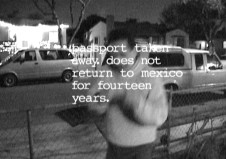
Timeline
Timeline
2002, color, 1:37. California Premiere
Description: Timeline is a short video that chronicles my father’s immigration to the United States. Told through fragmented memories, it traces his journey across decades—his work, wages, family life, small victories, and quiet defeats. The piece paints a portrait of resilience shaped by labor, sacrifice, and the pursuit of something better.
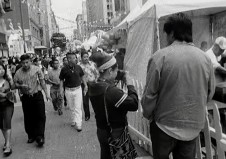
Una Esquina Del Mundo
Una Esquina Del Mundo
2004, 16mm, B&W, Sound, 43:30. World Premiere!
Una Esquina Del Mundo is an experimental hybrid short film that interweaves fiction, autobiography, and essay to explore the lives that shape one another across generations. Set largely in the working-class neighborhoods of Southeast Los Angeles, the film follows Rudy, an aspiring writer who spends his days changing oil at a small independent auto repair shop. Uncertain of both his artistic ambitions and his place in the world, he drifts between work, friendships, parties, and moments of impulsive violence, searching for a future he cannot yet imagine. His friendship with Myra, a young artist preparing to leave for art school, offers a quiet counterpoint. Fearless and self-assured, she recognizes possibilities in Rudy long before he is able to see them himself. Running alongside Rudy's story is a second narrative spoken by the filmmaker rather than the protagonist. These autobiographical reflections recount the migration of his parents from rural Mexico to Los Angeles, revealing the unseen histories that make Rudy's life possible. These parallel histories are never illustrated directly, but echo beneath Rudy's everyday experiences, revealing how the ordinary freedoms of one generation often rest upon the unseen struggles of another. Constructed through fragments rather than a conventional narrative, Una Esquina Del Mundo moves fluidly between observation, staged scenes, memory, and personal testimony. What begins in one corner of Southeast Los Angeles gradually opens onto another in rural Mexico, where intimate family histories quietly intersect with broader questions of migration, labor, education, gender, and artistic becoming. The film discovers that even the smallest corner of the world contains generations of lives, each carrying the weight of the places and people that came before.
Notes from Mexican America: The Battle to Belong
Notes from Mexican America: The Battle to Belong
2026, digital, color, sound 31:23. World premiere!
Notes from Mexican America is an unfinished work of cinematic cultural criticism composed of short films, documentary fragments, landscapes, archival footage, interviews, texts, and personal memories.
Drawing as much from literary and cultural criticism as from documentary and essay-film traditions, its intellectual lineage can be found in works such as D. J. Waldie’s Holy Land, Mike Davis’s City of Quartz, Richard Rodriguez’s Hunger of Memory, and Gloria Anzaldúa’s Borderlands/La Frontera: works that move freely between autobiography, history, cultural geography, criticism, memory, and theory.
Like those books, Notes from Mexican America begins with particular places and experiences but uses them to consider larger structures of American life. Through Mexican American life and Los Angeles, the project considers broader questions of language, labor, migration, assimilation, race, place, memory, and belonging.
Personal memory becomes a way of entering history; landscape becomes a form of evidence. Individual films function as entries or annotations in an expanding archive, accumulating across time without attempting to construct a definitive history or singular Mexican American experience.
Place as evidence. Memory as archive. Autobiography as criticism.