
Filmforum 50, program 12: Harry Smith’s Film #18: Mahagonny
Los Angeles Filmforum, the Harry Smith Archives, and The Philosophical Research Society's 7th House Screenings present
Filmforum 50, program 12: Harry Smith’s Film #18: Mahagonny
Closing event of The Cosmic Collage of Harry Smith
Sunday May 31, 2026, 4:00 pm
At 2220 Arts + Archives, 2220 Beverly Blvd. Los Angeles CA 90057
NOTE THE DIFFERENT START TIME!
Tickets: $15 general, $10 students/seniors, free for Filmforum members.
https://link.dice.fm/Xa619dc0bc71
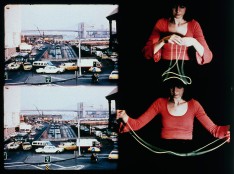
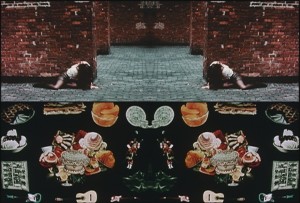
Experimental filmmaker, anthropologist, painter, and musicologist Harry Smith’s final film was an epic four-screen projection titled Mahagonny. Smith worked on this cinematic transformation of Kurt Weill and Bertolt Brecht’s opera Rise and Fall of the City of Mahagonny for over ten years and considered it his magnum opus. His friends have said that Smith was obsessed with the opera, playing it over and over in his room at the Chelsea Hotel. The film was shot from 1970 to 1972 and edited for the next eight years. The “program” of the film is meticulous, with a complex structure and order. The Weill opera is transformed into a numerological and symbolic system. Images in the film are divided into categories— portraits, animation, symbols and nature— to form the palindrome P.A.S.A.N.A.S.A.P.
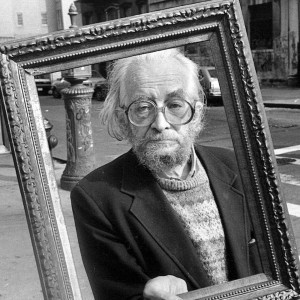
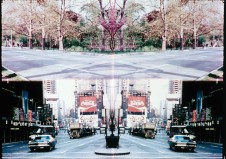
Mahagonny is an allegory of contemporary life; it explores the needs and desires of man amid the rituals of daily life in New York City. Smith’s New York, like Mahagonny, is a place where everything is permitted and the only sin is not having enough money. Much of the film takes place within the Chelsea Hotel. The film contains invaluable cameos of important avant-garde figures such as Allen Ginsberg, Patti Smith, and Jonas Mekas, intercut with installation pieces from Robert Mapplethorpe’s studio, New York City landmarks of the era, and Smith’s visionary animation.
Smith’s portrait of life in New York has strong affinities with the Brecht/Weill opera. Both are set in a somewhat mythical America, meant to exemplify life in capitalist society more generally. The opera caused a riot when it premiered in Leipzig, Germany, in 1930. Smith’s selection of the opera was prompted by his desire to create a similarly radical effect, although his Mahagonny provoked no mass demonstrations when it was screened in New York.
Smith identified with Weill’s transformation of popular music into an avant-garde presentation, and an analogy can be made between Weill’s work and Smith’s Anthology of American Folk Music (1952). For the Anthology, Smith took existing commercial recordings of traditional American folk music and reshaped them into a complex aural collage. Like Weill’s opera and the Anthology, Mahagonny blurs the line between “high” and “low,” traditional form and radical production, taking vernacular elements out of their original context to create a work that addresses many areas of culture that Smith had been investigating for over thirty years.
The editing of Mahagonny was a byzantine process. Smith created index cards for each scene and organized them according to various mathematical permutations in relation to the opera. Twenty-four scenes appear on each reel, following the order of the palindrome. Smith determined the length of each scene by taking into account certain constants in the viewer such as respiration and heartbeat. To synchronize the four screens with the operatic score, he made scrolls representing each edited reel plus a fifth scroll with the time code and list of scenes from the opera. The completed film consists of four 16 mm images tiled together on the screen to form one four-part image synced to the opera.
The film has had limited exposure, showing only six times in 1980 at Anthology Film Archives in New York with Smith present at each screening. His desire was to have it presented on four pool tables within a boxing ring but that was never realized. Smith designed frame filters within which the film would be projected accompanied by scrolling subtitles of the opera, but that project also never came to fruition.
This screening represents the completion of an ambitious preservation project by the Harry Smith Archives with the assistance of Anthology Film Archives. The artist’s original intention was to screen the film with four 16mm projectors. While we have duplicated and printed the 16mm elements, we have made a radical departure in transferring the 16mm screen sections to a single 35mm film in order to make it easier for the film to be exhibited. The original 16mm film masters have been optically printed onto a single ‘tiled’ 35mm film negative, and we are screening it digitally. -- Rani Singh, Harry Smith Archives
------
In celebration of what would have been his 103rd solar return, The Philosophical Research Society and Harry Smith Archives are proud to present THE COSMIC COLLAGE OF HARRY SMITH, a series dedicated to the boundless, unruly imagination of Harry Everett Smith—artist, filmmaker, folklorist, collector, and self-described alchemist of culture—presented in collaboration with 7th House, Los Angeles Filmforum, The American Museum of Paramusicology, The Getty Research Institute, Zebulon, and 2220 Arts + Archives.
A singular figure of the American avant-garde, Smith moved fluidly between disciplines and identities, assembling a body of work that resists containment. From his hand-painted and cut-out animation films—whose vivid abstractions and visionary logic would prove foundational to the development of psychedelic art—to his groundbreaking Anthology of American Folk Music—a meticulously curated, deeply idiosyncratic collection of early American recordings that would go on to inspire the folk revival of the 1960s and shape generations of musicians beyond—from ethnographic recordings to vast personal archives of string figures, paper airplanes, and occult diagrams, Smith approached the world as something to be gathered, transformed, and re-enchanted. His practice was not simply interdisciplinary—it was cosmological.
Deeply engaged with esoteric traditions, mysticism, and systems of hidden knowledge, Smith understood art-making as a form of spiritual inquiry. Alchemical thought, Kabbalah, and ritual practice were not peripheral interests but central frameworks through which he interpreted sound, image, and pattern. Across his work, correspondences emerge: between music and geometry, folklore and magic, the everyday and the divine.
Bringing together film screenings, an art exhibit, live musical performances, panel discussions, artist presentations, an online class, and a special visit to the Getty Research Institute’s Harry Smith collection, this series traces Smith’s expansive creative universe, reflecting both the breadth of his output and the coherence of his vision. Join us as we investigate and celebrate Smith’s remarkable life and works, where disciplines dissolve, curation becomes creation, and art serves as a bridge between the material and the unseen.
THE COSMIC COLLAGE OF HARRY SMITH
Thursday May 7 – Sunday May 31
Events:
Thursday May 7, 5:00pm – 7:00pm — Brain Drawings: The Art of Harry Smith Exhibition Opening Reception — in the Philosophical Research Society's Hansell Gallery. Free with RSVP, info & tickets at prs.org
Thursday May 7, 7:30 pm — Mind Maps: Exploring Harry Smith’s Hermetic Allusions feat. LATE SUPERIMPOSITIONS (1965) – Multimedia Presentation, Screening, & Panel Discussion w/ David Orr, William Kiesel, Jessica Hundley, Chuck Stein, and Rani Singh — at the Philosophical Research Society. $15, info & tickets at prs.org
Thursday May 21, 7:30 pm — Adam Green Explains Harry Smith + HEAVEN & EARTH MAGIC (1957) — A Lecture by Artist, Musician, and Harry Smith Enthusiast Adam Green plus screening of Smith's renowned film — Adam Green in person! — co-presented by 7th House & Los Angeles Filmforum — at the Philosophical Research Society. $20, info & tickets at prs.org
Sunday May 24, 11:00 am — Harry Smith’s Anthology as a Magical Instrument presented by Matt Marble of The American Museum of Paramusicology (Online Presentation) — As part of his online The Heretical Heart of Americana series, author, musician, and artist Matt Marble explores Smith's legacy as anthropologist and magician, examining the occult frameworks which charged the work that helped ignite the folk revival, pioneer innovations in film, and refuse the dead logics of colonialism and commerce that threaten to weaken the soul of the nation for profit. — Online via Zoom. $20, info & tickets at prs.org
Friday May 29, 12:00 pm — Show & Tell: Harry Smith Archive at the Getty Research Institute — A special guided viewing of material by the artist, musicologist, filmmaker, and esoteric icon — at the Getty Center Research Institute. Free with RSVP, info & tickets at https://www.getty.edu/calendar/harry-smith-archive/
Friday May 29, 7:00pm — A Celebration of Harry Smith’s Anthology of American Folk Music: Tribute Concert — Contemporary artists Eddie Ruscha, Kacey Johansing, Shannon Lay, Barry Johnson, Matt Baldwin, Frank Fairfield, David Elsenbroich and more TBA will interpret the music that inspired Smith on the Zebulon stage for one night only. — at Zebulon. $20, info & tickets at https://zebulon.la/
Sunday May 31, 4:00 pm — LA Filmforum presents Harry Smith’s MAHAGONNY (1980) screening — Harry Smith’s final film, an epic four-screen projection, cinematic transformation of Kurt Weill and Bertolt Brecht’s opera Rise and Fall of the City of Mahagonny which he considered it his magnum opus — co-presented by 7th House and the Harry Smith Archives. — at 2220 Arts + Archives. $15, info & tickets at www.lafilmforum.org and 2220arts.org
Mahagonny
Film #18, Mahagonny
By Harry Smith
United States, 1970-80, 16mm, presented digitally, 2 hours, 21 minutes
“You have to live Mahagonny, in fact be Mahagonny in order to work on it.” — Harry Smith