
Filmforum 50, program 11: Flaming Creatures: The Films of Jack Smith
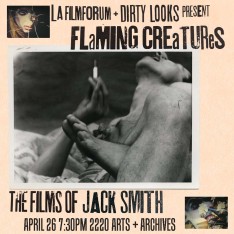
Los Angeles Filmforum and Dirty Looks present
Filmforum 50, program 11: Flaming Creatures: The Films of Jack Smith
Sunday April 26, 2026, 7:30 pm
At 2220 Arts + Archives, 2220 Beverly Blvd., Los Angeles CA 90057
Tickets: $15 general, $10 students/seniors, free for Filmforum members: https://link.dice.fm/a3661229c7e3
This screening is dedicated to Agosto Machado (????-2026), “a lady never tells.”
Appearing in the films are luminaries Jack Smith, Mario Montez, Francis Francine, Judith Malina, Tony Oursler and Tiny Tim. Flaming Creatures was produced for $300.
“Jack Smith was an underground visionary in every sense of the word. Jack poured glitter into everything he made: pasty creatures, plastic fantasias and moldy monsters. He was a performance artist, filmmaker, playwright, photographer, socialist, aesthete, installation artist, scene-stealer, writer, interventionist. He built a theater and movie-studio in his rickety loft out of street debris; an intricate and child-like universe, Cinemaroc, was equal parts Baroque and broke. For a contingency of art and theater fags and dolls, Jack, as Charles Ludlam once eloquently put it, “is the daddy of us all.” And quixotically, the fact that he remains a somewhat underground or cult figure, as opposed to canonized creature, attests to his legacy.
“Best known as a filmmaker, Jack made wild, indeterminable pictures. Flaming Creatures was his first finished film. Well, in truth, it’s his only finished film, since it ricocheted out of his hands when a trend of underground film raids made his opus a trophy for either side of a decency debate. Seized at the same time as Jean Genet’s Un Chant D’amour and Kenneth Anger’s Scorpio Rising, Creatures made it all the way to the Supreme Court, who could detect little value in its over-exposed rumpus of genitalia, transvestitism, baroque orgies and dance dervishry. Meanwhile, Susan Sontag and Jonas Mekas heralded the film as high art, hijacking (so Jack saw it) his vehicle to bolster their tastemaker status. So, Jack moved forward making movies that couldn’t be screened without him. He shot epics and edited them in front of you. Normal Love, No President, I Was a Male Yvonne de Carlo. A screening could be ten minutes or four hours, as Jack huddled in the back with the projector, throwing on scarred 78s to make the soundtrack, chopping up and taping together filmstock like it was sculpture.
“This was but one of the many ways that Jack restlessly performed. He also hosted theater pieces in his Greene Street loft that were both must-sees of the ’70s art world and dubious endeavors. He would host an event at midnight and allow the audience to linger for 4, maybe 5 hours before stepping onto the stage. Because for Jack, life was art, life was theater. There was no distinction, really, between the prelude and the event. Which reflected Jack’s status as a fierce anti-capitalist. Waiting became a concentrated practice, as important as the paid-for spectacle. Waiting was participatory. After the irate had fled, Jack would commence. Those who remained were dedicated, not “the scum of Baghdad.” -- Bradford Nordeen, from “What’s Underground?: The Films of Jack Smith” published in 2011
Jack Smith (1932–1989) was a New York-based filmmaker, photographer, and actor known for his pioneering influence in experimental filmmaking and performance art. Smith moved to New York City in 1953, where he attended film classes at the City College of New York, finding employment as a photographer. He studied dance with Ruth St. Denis, direction with Lee Strasberg, and worked as an actor and assistant with Ken Jacobs before shooting his first film, Scotch Tape, in 1959. His best-known film, Flaming Creatures (1963), was confiscated by the New York Police Department and banned throughout the United States due to nudity and charges of obscenity. Smith never again created a finished artwork. His next film, Normal Love (1963), was often re-spliced as it ran, repeatedly reedited, and regularly awarded new titles such as Normal Fantasy, Exotic Landlordism of Crab Lagoon, and The Great Pasty Triumph. From the late 1960s into the 1980s, Smith focused on theater and performance, and combined live happenings with screenings of films and slideshows. Throughout his life, Smith pioneered a radical artistic practice that challenged the economic conditions of late capitalism, fixed definitions of gender and sexuality, and the production and dissemination of art itself. Smith’s influence pervades experimental filmmaking and performance art in the US to this day, and is present in the works of Andy Warhol, John Waters, Laurie Anderson, and Cindy Sherman, among countless others. In 1998, The Institute for Contemporary Art/P.S.1 Museum mounted Jack Smith: Flaming Creature: His Amazing Life and Times, a retrospective of his work that traveled to Pittsburgh, Pennsylvania; Berkeley, California; and Berlin, Germany.
All screening in 16mm, TRT 72 min.
Mature subject matter (ages 18+ only)
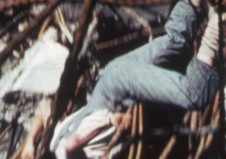
Scotch Tape
Scotch Tape
1959-62, 16mm, b&w, sound, 3 min.
New distribution print courtesy of the Gladstone Gallery.
With Jerry Sims, Ken Jacobs and Reese Haire. 16mm Kodachrome shot on the rubble strewn site of the future Lincoln Center. The title arises from the piece of scotch tape which had become wedged in the camera gate.
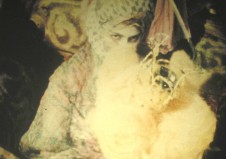
Yellow Sequence
Yellow Sequence
1963-65, 16mm, color, sound on CD, 15 min.
New distribution print courtesy of the Gladstone Gallery.
This is a gold-toned coda to Normal Love.
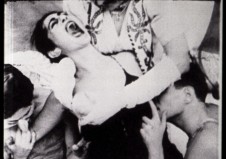
Flaming Creatures
Flaming Creatures
1962, 16mm, b&w, sound, 43 min.
New distribution print courtesy of Gladstone Gallery.
"[Jack Smith] has graced the anarchic liberation of new American cinema with graphic and rhythmic power worthy of the best of formal cinema. He has attained for the first time in motion pictures a high level of art which is absolutely lacking in decorum; and a treatment of sex which makes us aware of the restraint of all previous filmmakers. "He has shown more clearly than anyone before how the poet's license includes all things, not only of spirit, but also of flesh; not only of dreams and of symbol, but also of solid reality. In no other art but the movies could this have so fully been done; and their capacity was realized by Smith." – Film Culture
"During its final deliberation, the selection jury decided to state explicitly that the majority of its members recognized the aesthetical and experimental qualities of the film FLAMING CREATURES by Jack Smith, but had to ascertain unanimously that the showing of it was impossible in regard to Belgian laws." – Program Notes, Third International Experimental Film Competition, Knokke-Le-Zoute, Belgium, 1964
Song for Rent
Song for Rent
1969, 16mm, color, sound on CD, 4 min.
New distribution print courtesy of the Gladstone Gallery.
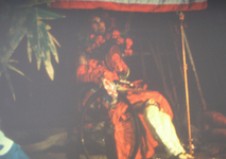
Filmmaker Jack Smith stars in this funny short film, playing the cadaverous matron Rose Courtyard (inspired by Rose Kennedy).
Hot Air Specialists
Hot Air Specialists
1980, 16mm, color, sound on CD, 7 min.
New distribution print courtesy of the Gladstone Gallery.
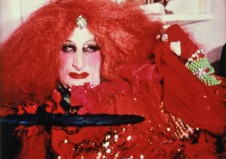
A documentation of a Jack Smith drag performance featuring a large red wig.