
Filmforum at 50, program 1: Classics of Los Angeles Experimental Film
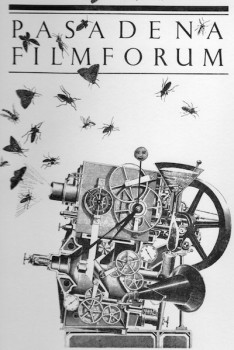
Los Angeles Filmforum presents
Filmforum at 50, program 1: Classics of Los Angeles Experimental Film
Sunday November 16, 2025, 7:30 pm
At 2220 Arts + Archives, 2220 Beverly Blvd., Los Angeles CA 90057
Tickets: $50 special Filmforum at 50 donation; $15 general, $10 students/seniors, free for Filmforum members: https://link.dice.fm/Lf6d9e9bc00c
We hope you will join us for this special event, the launch of our celebration of Filmforum’s 50th year!
As the USA prepared to celebrate its bicentennial year, the nation took little notice of one small non-profit organization dedicated to screening avant-garde films. This cheery oasis of sanity and unconventionality amidst the miasma of Southern California arose from the efforts of Terry Cannon. The Neighborhood Church in Pasadena (at 301 N. Orange Grove Blvd) hosted that first season. After a special event screening in November 1975, Filmforum’s first full season, January-March, 1976, set a clear, high standard for the programs ever since. Starting off with four weeks dedicated to “The Ethnographic Film,” in its first three months Filmforum embraced “The American Avant-Garde: West Coast,” “Thee Films of Paul Robeson,” “Sixteen Films Under Five Minutes,” “Films of Sexy Humor,” and “Women in Film.” We will be celebrating the 50th anniversary of Filmforum with multiple screening and events over the next year with blasts from the past, films looking to the next fifty years, and visits from former directors and programmers of the organization. Tonight, we start with some highlights of experimental films made in Los Angeles, several of which by people linked to Filmforum. Works by Amy Halpern, Sara Kathryn Arledge, James Whitney, Adam Beckett, Beth Block, Chick Strand, Pat O’Neill, Craig Rice, and more!
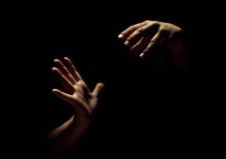
Invocation
Invocation
By Amy Halpern
1982, 16mm, color, silent, 2 min.
"A temporary sculpture; an invitation and benediction." (AH)
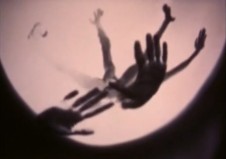
Introspection
Introspection
By Sara Kathryn Arledge
1941, 16mm, color, sound, 7 min.
"Disembodied parts of dancers are seen moving freely in black space ... [they] form a moving and rhythmic three dimensional design of semi-abstract shapes." - Lewis Jacobs, "Avant-Garde Production in America," Experiment in the Film, Grey Walls Press, London, 1949
Purpose: to demonstrate a (then) new dance medium totally different from the stage. Audience: general public, dancers, artists.
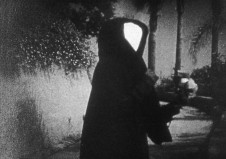
Meshes of the Afternoon, by Maya Deren & Alexnader Hammid
Meshes of the Afternoon
By Maya Deren & Alexnader Hammid
1943, 16mm, b&w, sound, 14 min.
In 2015 the BBC named the film the 40th greatest American movie ever made.
A large flower, the silhouette of a figure briskly walking away, a house key, a bread knife, a telephone receiver resting off the hook, and a spinning phonographic turntable define the shifting functional elements in Meshes of the Afternoon from which the film's evolving, malleable construct - the fragile and tenuously interconnected mesh of actual and perceived reality - is intriguingly (and ingenuously) mapped….
From this deceptively simple introductory premise, Maya Deren modulates the mise-en-scene of seemingly mundane objects to create overlapping, yet non-intersecting planes of existential reality, using permutations of recurring images - mirrored surfaces (the apparition's face, polished metal spheres, a hand mirror), glass, duality and doppelgangers - to represent variably interlocking narrative fragments of observation, inference, deduction, and memory.
Unfolding with the narrative discontinuity characteristic of nouvelle roman literature (creating an idiosyncratically dissociative filmic language that also characterizes Alain Resnais' subsequent feature films, particularly Last Year at Marienbad and Je t'aime, je t'aime), the film posits a series of subtle structural, temporal, and logical mutations, creating a sublimely recursive, mind-bending meditation on the interaction between experience and memory, domestic banality and violence, imagination and causation.
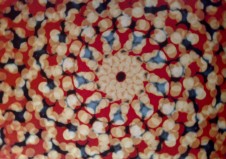
Lapis, by James Whitney. Image courtesy of Whitney Editions, Los Angeles, CA
Lapis
By James Whitney
1963-1966, 16mm film, color, sound, 10 minutes
Unpublished work copyright 1966, James Whitney
Restoration copyright 2018, Whitney Editions, LLC
James Whitney's Lapis is a classic work of abstract cinema, a 10-minute animation that took seven years to create using mechanical analogue computer equipment. In this piece, smaller circles oscillate in and out in an array of colors evoking a metaphysical meditation while being accompanied by Indian sitar music. The patterns become hypnotic and trance-inducing. This work clearly correlates the auditory and the visual and is a wonderful example of the concept of personal abstract filmmaking.
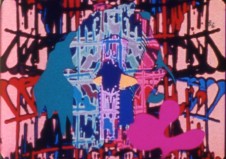
Kitsch In Synch, by Adam Beckett
Kitsch In Synch
Kitsch In Synch, by Adam Beckett
1975, 16mm, color, sound, 4.5 minutes
This is an abstract animation that seems to get laughs. The soundtrack is why, mainly; it sounds like a large group of demented ducks enthusiastically and persistently seeking oneness with the all, via energetic chanting. BUBUBABU!!! The imagery is elaborate, brightly colored, and every single damned beat in the soundtrack has its own little bump.
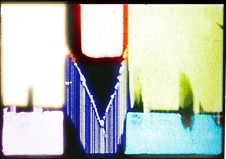
Twelve, by Beth Block
Twelve
By Beth Block
1977, 16mm, color, sound, 9 min.
The first three parts of a twelve-part film which explores the history of imagery. The first part consists of hand-painted and scratched film, the second part incorporates the use of negative space and the third part uses elaborate optical printing techniques to incorporate photographic imagery into the increasingly complex images.
Beth Block was president of the Filmforum board for a number of years.
Cartoon Le Mousse
By Chick Strand
1979, 16mm, b&w, sound, 15 minutes
"Chick Strand is a prolific and prodigiously gifted film artist who seems to break new ground with each new work. Her recent "found footage" works such as CARTOON LE MOUSSE, are extraordinarily beautiful, moving, visionary pieces that push this genre into previously unexplored territory. If poetry is the art of making evocative connections between otherwise dissimilar phenomena, then Chick Strand is a great poet, for these films transcend their material to create a surreal and sublime universe beyond reason." - Gene Youngblood
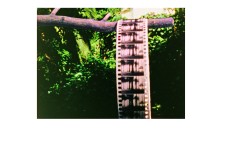
Foregrounds, by Pat O'Neill
Foregrounds
By Pat O'Neill
1979, 16mm, color, sound, 13.5 minutes
"FOREGROUNDS, like SAUGUS SERIES, is devoted almost entirely to carefully constructed spatial ambiguities. The most visceral of these prints a rotating boulder, occupying half of the screen, over a slow lateral pan across the desert (painted by Neon Park). A faint superimposition of leaves on top of the landscape has the effect of pushing its vista farther back in space. Correspondingly, the boulder bulges out of the picture-plane like a Cezanne apple. The effect is so strong that even when O'Neill begins to animate 'scratches' over the image, one's eye refuses to surrender the illusion of volume." - J. Hoberman, The Village Voice
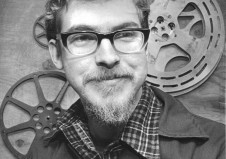
Terry Cannon, Filmforum founder
Filmforum Film
By Craig Rice
1980, 16mm, b&w, silent, 4 min.
Craig Rice, a Filmforum member whose work had screened there, made a delightful documentary, 'Filmforum Film,' showing the neighborhood, Cannon at work, and some of the audience in attendance. -- David James, The Most Typical Avant-Garde, 2005
Terry said that it was made as their report for the NEA for a grant received.